Have you ever been in a discussion with someone about something important to you...say, politics or religion or education and you find that you and your colleague are in sharp disagreement, and you really don't want to start a row, so someone says something to the effect, "You have your way of looking at things, and I have mine and that's okay" ?
That happens a lot among polite people who don't want to lose a friendship or stop speaking to a relative because they didn't vote the same way in the last election.
You can't argue with someone else's experience. But when they start using their own experience as proof that their opinions are true in all cases, you've got a problem. The problem with relativism is that each individual gets to choose their own reality based upon their own experiences. In effect, each person becomes their own little god. And when they try to ignore the conflict that arises when different people have radically different experiences, they say, "You have your truth, and I have mine."
Taken to the extreme, this idea that opposite opinions can be equally valid is one of the aspects of relativism which has taken hold of our modern culture in our effort to promote "tolerance," "empathy," and "diversity."
On second thought, some opinions are not considered by our culture to be equally valid if they infringe upon the real or supposed rights of a protected class of people. Just try sending your child to school in a t-shirt that says something like "Adam and Eve, not Adam and Steve."
Tolerance, empathy and respect for diversity are noble qualities, don't get me wrong. I want my kids to be tolerant of their annoying siblings, empathetic to the plight of the poor and respect people who don't speak English, but I don't want them to think it is good to be annoying, poor or ignorant.
Mark Shea spoke at Theology on Tap last night in Denver, and his topic was "101 Reasons NOT to be Catholic." He listed the various reasons people object to Catholic beliefs, such as: "The Catholic Church is against Choice," and "The Catholic Church says believers can lose their salvation." Or, "The Catholic Church is anti-sex," and "The Catholic Church wants people to have lots of babies." He juxtaposed these radically different claims, usually made by radically different folks, to show that perhaps the Church is really in the middle...and the observers are on the extremes.
Jesus promoted tolerance, empathy and diversity more so than any other person of his day. After all, he ate with sinners, told rich folk to give all their money to the poor and collected a motley assortment of followers to be his disciples.
The relativistic person who says, "Your beliefs are true for you and my beliefs are true for me," are really saying there can be two competing claims of "truth" that are both equally valid. They are really the ones in the extreme. But remember, no one really believes that in the important areas of life, (religion, politics and education, for example), opposing viewpoints have any merit. We're just trying to be polite.
But in those important areas of our lives, we need to assert our claim of truth. For example, those who claim that a woman has the "right to choose" abortion of her unborn child because she is the only one who really knows her situation and it is between "the woman and her god," are forgetting there is a competing "reality" in this situation, and that is the reality the unborn child experiences. If the promoters of relativism were really true to their beliefs, they would consider that others have competing claims that are equally valid and worthy of respect. The unborn child's claim to life should therefore hold equal weight to the claim of the woman for independence from the unborn child. In a span of nine months or less, the woman's claim for independence can be granted, and the child can be placed for adoption. In this incidence of competing claims for reality, it seems logical that both claims should be balanced so as to protect the rights of each to the greatest extent possible and doing the least harm to each.
The teachings of the Catholic Church, therefore, protect the rights of both parties to the greatest extent. Far from rejecting the claims of the woman for independence, the Church recognizes the reality of the unborn and fights to have the value of each person protected.
Showing posts with label philosophy. Show all posts
Showing posts with label philosophy. Show all posts
Saturday, November 07, 2009


Wednesday, November 04, 2009
The lost tools of learning: will we ever find them?
I've been doing a lot of off-blog debating these days. It concerns the direction our little homeschooling co-op turned public school option program is going.
We have been happily partaking of the federal trough of taxpayer funded homeschooling resources through a great program called Home Option Program of Education. What began as a few moms sharing teaching efforts in a Christian co-op has expanded to utilize public funds for teachers and facilities and is now looking at creating their own charter high school.
I went to a few charter committee meetings during the summer to share my ideas for curriculum and a classical education, having used such a method, with some degree of success, for the past 18 years of homeschooling. As one of the early members of the program, and with four high school graduates under my belt, I figured they'd want to listen to my ideas.
Boy, was I wrong!
Little did I know the charter committee had already decided their course of action would have no part in medieval ideas of classical education, for they had already charted their course for "collaborative learning" and "critical thinking."
There's nothing like having to do a little research in educational theories and methods to fully convince one of the merits of homeschooling. I just did another re-read of Dorothy Sayer's essay, The Lost Tools of Learning. I'd forgotten just how delightfully refreshing it is to read her essay, first presented at Oxford in 1947.
I was struck by just how appropos this excerpt is today. Perhaps even more so now than it was in 1947:
For we let our young men and women go out unarmed, in a day when armor was never so necessary. By teaching them all to read, we have left them at the mercy of the printed word. By the invention of the film and the radio, we have made certain that no aversion to reading shall secure them from the incessant battery of words, words, words. They do not know what the words mean; they do not know how to ward them off or blunt their edge or fling them back; they are a prey to words in their emotions instead of being the masters of them in their intellects. We who were scandalized in 1940 when men were sent to fight armored tanks with rifles, are not scandalized when young men and women are sent into the world to fight massed propaganda with a smattering of "subjects"; and when whole classes and whole nations become hypnotized by the arts of the spell binder, we have the impudence to be astonished. We dole out lip-service to the importance of education--lip- service and, just occasionally, a little grant of money; we postpone the school-leaving age, and plan to build bigger and better schools; the teachers slave conscientiously in and out of school hours; and yet, as I believe, all this devoted effort is largely frustrated, because we have lost the tools of learning, and in their absence can only make a botched and piecemeal job of it.
I would love to say that after 18+ years of homeschooling, I've gotten it right and I am doing a great job of introducing my kids to the lost tools of learning, but the more I learn, the more I realize I don't know. I just hope my kids end up being smarter than me. Some of them already are!
We have been happily partaking of the federal trough of taxpayer funded homeschooling resources through a great program called Home Option Program of Education. What began as a few moms sharing teaching efforts in a Christian co-op has expanded to utilize public funds for teachers and facilities and is now looking at creating their own charter high school.
I went to a few charter committee meetings during the summer to share my ideas for curriculum and a classical education, having used such a method, with some degree of success, for the past 18 years of homeschooling. As one of the early members of the program, and with four high school graduates under my belt, I figured they'd want to listen to my ideas.
Boy, was I wrong!
Little did I know the charter committee had already decided their course of action would have no part in medieval ideas of classical education, for they had already charted their course for "collaborative learning" and "critical thinking."
There's nothing like having to do a little research in educational theories and methods to fully convince one of the merits of homeschooling. I just did another re-read of Dorothy Sayer's essay, The Lost Tools of Learning. I'd forgotten just how delightfully refreshing it is to read her essay, first presented at Oxford in 1947.
I was struck by just how appropos this excerpt is today. Perhaps even more so now than it was in 1947:
For we let our young men and women go out unarmed, in a day when armor was never so necessary. By teaching them all to read, we have left them at the mercy of the printed word. By the invention of the film and the radio, we have made certain that no aversion to reading shall secure them from the incessant battery of words, words, words. They do not know what the words mean; they do not know how to ward them off or blunt their edge or fling them back; they are a prey to words in their emotions instead of being the masters of them in their intellects. We who were scandalized in 1940 when men were sent to fight armored tanks with rifles, are not scandalized when young men and women are sent into the world to fight massed propaganda with a smattering of "subjects"; and when whole classes and whole nations become hypnotized by the arts of the spell binder, we have the impudence to be astonished. We dole out lip-service to the importance of education--lip- service and, just occasionally, a little grant of money; we postpone the school-leaving age, and plan to build bigger and better schools; the teachers slave conscientiously in and out of school hours; and yet, as I believe, all this devoted effort is largely frustrated, because we have lost the tools of learning, and in their absence can only make a botched and piecemeal job of it.
I would love to say that after 18+ years of homeschooling, I've gotten it right and I am doing a great job of introducing my kids to the lost tools of learning, but the more I learn, the more I realize I don't know. I just hope my kids end up being smarter than me. Some of them already are!
Wednesday, July 29, 2009
Don't know much about philosophy...
I really have a very dull life. Sometimes I wonder what the heck I'm doing blogging at all.
Not so my dear (old) friend, The Philosopher-Mom, who's upcoming visit to the big square state has me nearly giddy with delight. Yes, she has a PhD, and it don't stand for PhillyDelphia...
I am in awe of her and her boundless energy and amazing mind and I'm hoping some of it will rub off on me when she comes for a visit next week.
Never mind that she arrives two days after my daughter, Lizzy returns from the south of France with our 16 yr-old French guest and their room is currently trashed.
Never mind that the lovely mutt (yep, dog #2) we were supposed to acquire today is coming tomorrow instead...(perhaps Blog Dog will fill us in on the finer details at a later date).
Never mind that two of my dramatic kids are in two separate plays that week and doing technical rehearsals the entire week preceding the performances.
Never mind that our illustrious taekwondo instructor will be back from his honeymoon and expecting us to be in class, eager and ready to endure his workouts all week.
Never mind that my house is in utter chaos, my dishwasher died, my sofa is an embarrassment and the hailstorm destroyed our siding.
Never mind that my eldest is planning a trip, for which she leaves tomorrow, which entails driving to Oregon; flying to Vancouver, BC; flying to Tokyo; flying to Singapore; hoping boyfriend's father will then buy them tickets to fly to Bali where dear daughter and boyfriend will stay with his parents while touring the islands of Indonesia where said boyfriend grew up, then repeating the entire trip backwards before college classes begin again in late August.
I hope Philosopher-Mom will give me some of whatever keeps her going...
Not so my dear (old) friend, The Philosopher-Mom, who's upcoming visit to the big square state has me nearly giddy with delight. Yes, she has a PhD, and it don't stand for PhillyDelphia...
I am in awe of her and her boundless energy and amazing mind and I'm hoping some of it will rub off on me when she comes for a visit next week.
Never mind that she arrives two days after my daughter, Lizzy returns from the south of France with our 16 yr-old French guest and their room is currently trashed.
Never mind that the lovely mutt (yep, dog #2) we were supposed to acquire today is coming tomorrow instead...(perhaps Blog Dog will fill us in on the finer details at a later date).
Never mind that two of my dramatic kids are in two separate plays that week and doing technical rehearsals the entire week preceding the performances.
Never mind that our illustrious taekwondo instructor will be back from his honeymoon and expecting us to be in class, eager and ready to endure his workouts all week.
Never mind that my house is in utter chaos, my dishwasher died, my sofa is an embarrassment and the hailstorm destroyed our siding.
Never mind that my eldest is planning a trip, for which she leaves tomorrow, which entails driving to Oregon; flying to Vancouver, BC; flying to Tokyo; flying to Singapore; hoping boyfriend's father will then buy them tickets to fly to Bali where dear daughter and boyfriend will stay with his parents while touring the islands of Indonesia where said boyfriend grew up, then repeating the entire trip backwards before college classes begin again in late August.
I hope Philosopher-Mom will give me some of whatever keeps her going...
Thursday, July 02, 2009
The reasonableness of Christianity
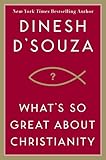 What's So Great About Christianity by Dinesh D'Souza
My review
rating: 5 of 5 starsI had the opportunity to hear Dinesh D'Souza debate atheist Christopher Hitchens at CU Boulder this past winter (see my blog) and I heard this book mentioned.
D'Souza takes the opportunity to go into great depth into the topics that were touched upon at the debate. When I first began reading this book, I though it was just going to be a retelling of the debate I heard, but D'Souza goes into much greater detail here and without interruption and snide remarks from Hitchens.
This book should be on the required reading list of all Christians. D'Souza uses science, philosophy and atheism's own words to show the utter truth, beauty and logic of Christianity.
D'Souza denounces the atheism of Darwinism, while at the same time praising evolutionary theory as our "best guess" for the current type of life we have on earth. But don't sit back and think the argument is over. D'Souza goes on to point out all the questions that evolutionary theory can't answer, such as the complexity of the cell, or DNA strands or even the origin of life itself. Darwin's theory assumed life already existed, so current Darwinists' (such as Richard Dawkins) attempts to explain away evolution as a great way to avoid needing an Intelligent Designer, have basically shot themselves in the foot. They look very foolish trying to come up with increasingly complex ways of describing the origins of life, the origins of the universe and how it all began. D'Souza reveals Dawkins' bias against God and for atheistic evolution using Dawkins' own words: "The theory of evolution by cumulative natural selection is the only theory we know of that is in principle capable of explaining the existence of organized complexity. Even if the evidence did not favor it, it would still be the best theory available."[emphasis mine:].
One of my favorite chapters in the book is "The World Beyond our Senses: Kant and the Limits of Reason." I have never taken a class in philosophy and I know very little about the topic. But D'Souza does an excellent job at explaining the thinking behind the philosophical underpinnings of Kant and the limits of our senses. In brief, we can't use our senses to know God, "so", the atheists tell us, "He must not exist." Kant's reasoning was that reality is not what our senses tell us. In fact, there is much about reality and knowing and being that our senses can not inform us. For example, I can know what a dog is: what one looks like, smells like, feels like, sounds like. I can even cut him open and examine his insides and tell much about the biology of the dog. One thing I can not do, however, is know what it is like to actually "be" a dog. The reality of being a dog is something we, as humans can never know. It is beyond our reach. If we could put a camera inside a dogs head and follow it around and monitor brain waves and measure internal temperatures we still would only know what it is like to be a human observing a dog. We can never "be" a dog.
As D'Souza so aptly puts it, "Kant's accomplishment was to unmask the intellectual pretension of the Enlightenment: that reason and science are the only routes to reality and truth." Certainly modern education today, particularly at the university level, tells us that all we need to know we can know through reason and science. Religion is the crutch for the weak. The fairy tales for the unenlightened and uneducated.
But D'Souza continues steering us on the path he has laid. After our introduction to Kant, he takes us into the realm of miracles. Did you know that Christianity is the only major religion in the world today that depends upon miracles? Other religions may support or allow them, but only Christianity depends upon the miraculous. That would be the central tenet of Christianity--Christ's resurrection. At this the atheist scoffs. Virgin births and dead men come to life! How utterly absurd. Yet we have already read that Kant's secular reasoning has led us to the conclusion that we can't know everything through our senses alone. And the physicists have told us our physical laws are such that if altered even one iota (such as the gravitational force), we would not exist. Therefore, we have some indication that there is a great force beyond ourselves that we can't quite perceive. If that force is God, and God has created nature and the physical laws, then what sane person could deny He can alter them according to His plans? Thus we see the reasonableness of believing in miracles.
I can't recommend this book more strongly. I believe D'Souza's book ranks up there with Mere Christianity as being one of the foundational books every Christian should read.
View all my reviews.
Subscribe to:
Posts (Atom)