Showing posts with label book reviews. Show all posts

Friday, June 03, 2011

What's Wrong with Feminism?

The Flipside of Feminism: What Conservative Women Know -- and Men Can't SayThe Flipside of Feminism: What Conservative Women Know -- and Men Can't Say by Suzanne Venker

My rating: 5 of 5 stars

Author Suzanne Venker dares to express the unspoken thoughts of many women (and perhaps an equally large number of men) who have been indoctrinated by the philosophies of modern feminism that something is wrong with the way we view the roles of men and women. What's wrong with feminism? Venker dares to tell it like it is. She gives compelling examples from both sides of the debate using their own arguments to show us how feminism has messed up society and our happiness as men and women by telling us our traditional roles don't matter. Feminism insists women are just as capable of being in the workforce as are men and denies the basic fact that children are happier and better adjusted when they have their mothers at home. Venker masterfully lays out the agenda of feminists and shows how government has taken the place of husbands as providers of families in order to keep more mothers in the workforce. The result has been devastating to children, mothers and the fathers who have been cast aside by feminists who view them as disposable.

The women's movement and modern feminism is nearly 50 years old and what has it gotten us? Higher divorce rates thanks in part to no-fault divorce laws, single motherhood at an unprecedented rate of 40%, and sexually transmitted diseases at an all-time high. Meanwhile, abortion on demand has resulted in the destruction of 53 million lives. That's one-sixth the population of the United States that have been terminated since Roe v. Wade became the law of the land in 1973. To put it into perspective, that's the current combined populations of Alaska, Arkansas, Connecticut, Delaware, Hawaii, Idaho, Iowa, Kansas, Kentucky, Louisiana, Maine, Mississippi, Montana, Oregon, Oklahoma, Nebraska, Nevada, New Hampshire, North Dakota, South Dakota, Rhode Island, Utah, Vermont, West Virginia and Wyoming. Something is wrong with a society that says it's more important for women to continue to live their lives for themselves than to bring new life into the world.

I was raised with the notion that women are equal to men and have just as many opportunities available to them. However, no one told me about the deeply-rooted mother bear that lurked inside me making me feel as if my heart had been ripped out each morning when I'd drop my toddler daughter off at the day care center only to return 8 or more hours later and see her still crying and alone in the corner. My protective instinct wanted to whisk her away from the child care professionals who insisted she only needed to be "broken in" and everything would be fine. When her brother was born, my biology told me my baby needed to nurse, and sitting in a bathroom stall trying to express milk, while he was miles away with another mother being paid to care for him, wasn't going to cut it. I was convinced my children needed me home more than the Navy needed me, so I resigned my commission with all the perks and benefits of being an officer, in order to stay home and change diapers, coax children to sleep at naptime and be there when they awoke.

This book has challenged me to re-think some of my long-held beliefs that women and men can and should do the same things. My own experiences as a wife and mother of many children, along with recent scientific studies that show the significant differences in male and female physiological and psychological make-up, tells me the differences between males and females are far greater than our sexual organs.

This is an important book that should be read by all parents and educators.

View all my reviews

Friday, May 13, 2011

Why we need to learn Latin

The Devil Knows Latin: Why America Needs the Classical TraditionThe Devil Knows Latin: Why America Needs the Classical Tradition by E. Christian Kopff

My rating: 3 of 5 stars


In his introduction, University of Colorado Classics Professor Kopff, relates the source of his book's title. The late Fr. Ronald Knox, when asked to perform a baptism in the vernacular, responded: "The baby does not understand English and the Devil knows Latin."

The professor recommends the study of classical literature in their original language (likely Latin or Greek). He convinced me by page 26, that we should be learning Latin and that it was by no means a dead language. He tells us, "...of the 100 most commonly used words in English, only 10 or so come from Latin. Of all the English words, however--over a million in the latest dictionaries--more than half are of Latin origin, and those of Greek origin take up much of what remains."

The book is divided into three sections. The first section details the reasons we need to study the classics. The classics are narratives that tell a story and the story relates to who we are as human beings in the Western tradition. Learning the stories of our civilization helps us to put all the pieces of our education together. We begin to understand why we have the history we have and the underlying causes of world events throughout our history. We begin to understand how language, science, math, art and music fit into this enormous puzzle. We begin to understand the part religion, and Christianity in particular, plays. In short, our lives make more sense when we understand how all the pieces fit together and how we fit into the story.

The first section has other great insights as well. For example, the idea that tradition limits our creativity and advancement, he puts to rest. He points out "...languages are traditions learned by each generation from the preceding one and then taught to the next." Likewise, religion, science and history, are all built upon traditions. Prof. Kopff points out the beginning of science was in the sixth century B.C., when a man named Thales first proposed the world was "...a rational system, comprehensible to human minds," without relying on ancient gods for explanation. That the world is a rational system is itself a profound idea and one that we too often take for granted today. So, the first assumption in science is that the Universe is ordered and the second is that it is logical. These two ideas go back to the sixth century B.C. The third assumption of science is that the Universe is mathematical. This goes back to Pythagoras, who lived at the end of the sixth century B.C. Thus began the tradition of science.

The chapter of the first section outlines the need for the classics and the liberal arts in our grammar schools, high schools and universities. Kopff recommends children in the early years start out learning the three R's, followed by Latin, Greek and mathematics. The other subjects he recommends: history, mythology, English vocabulary and syntax and basics of government, can be taught in relation to the first subjects.

The second section discusses widely varying authors, philologists and philosophers. It was with this section that I found the most difficulty following the thread that links them all together. I felt rather like I'd stumbled into one of his classroom lectures by mistake. I was unprepared and unfamiliar with most of the names he was discussing so intimately. His somewhat frequent references to President Bill Clinton and the Monica Lewinsky scandal were rather amusing though dated. I wondered what the good professor would have to say about our present state of affairs.

The third section discusses popular culture--specifically movies--and how the ones that are most meaningful get their inspiration or find their source in some of the great classics of ancient Greece and Rome. Once again I found myself stumbling along with many of his stories since I haven't seen most of the movies he discusses and those I had seen, I wasn't always as thrilled about them as he was. For example, he thought Disney's "The Lion King" had "character and maturity." I prefer "Beauty and the Beast" for a moral tale of redemption and sacrifice.

The book reads like a collection of lectures put together to make a book. If I had been in his class and read the reading list before attending his lectures, maybe I would've better understood some of his points. Although I liked the book, it's probably not one I'd recommend to homeschoolers who want to know why they should study the classics. Leigh Bortins' book, "The Core," does a much better job of that.

The appendix, aptly entitled, "Doing it on Your Own," would be a great booklet for homeschoolers, especially if it were combined with the first section of the book. Prof. Kopff lists his suggestions for Latin curriculum to do at home, as well as Greek, along with some primary sources that would be good for beginning Latin and Greek students to read in the original.


View all my reviews

Thursday, May 05, 2011

Book review: "The Core"

A year ago I first heard about "Classical Conversations," a Protestant organization that promotes classical education among homeschoolers and has co-ops throughout the country. I looked into their program and was very excited about what I was reading. We decided not to participate, however, when it became apparent there were some anti-Catholic elements in the curriculum and Statement of Faith. While I can't recommend the group to Catholics, I can, however, strongly recommend The Core: Teaching Your Child the Foundations of Classical Education, by Leigh Bortins, the founder of Classical Conversations. You can read my book review here.

Friday, March 11, 2011

"UnPlanned": The Abby Johnson story

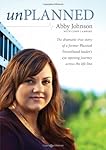
Unplanned: The Dramatic True Story of a Former Planned Parenthood Leader's Eye-Opening Journey across the Life LineUnplanned: The Dramatic True Story of a Former Planned Parenthood Leader's Eye-Opening Journey across the Life Line by Abby Johnson

My rating: 5 of 5 stars

Abbey Johnson was the director of a Planned Parenthood abortion clinic in Bryan, Texas until the day she walked off the job and sought refuge at the Coalition for Life offices down the street from that clinic. She tells the story of how she went from naive college student, wanting to help women in crisis situations, to Planned Parenthood Employee of the Year and director of one of their most successful abortion clinics in just eight years. When she was called to assist at an ultrasound-guided abortion one day her heart was changed forever. She knew she could no longer work for Planned Parenthood and even more shocking, she realized she needed to join forces with those who had been praying outside her workplace for all those eight years.

She talks to her readers like old friends. She reveals herself to us with all her flaws, including her own secret abortions. I most appreciated the fact that she didn't try to make excuses for herself or others. She just told her story with openness and honesty. I was also deeply moved by her love for her friends on both sides of the abortion issue. She even speaks kindly of the notorious late-term abortionist who was murdered in his own church, Dr. George Tiller. She was appalled at the abortions he performed, even though she thought he had a kind and gentle manner. She never approved of late-term abortions, even as she served at the helm of an abortion clinic.

As one who has participated in peaceful prayer vigils outside Planned Parenthood clinics, I've experienced the feeling of helplessness as women are ushered into the clinics by volunteers who do their best to shield women from hearing the voices of pro-lifers offering support and help. Too often, the peaceful pro-lifers' voices are drowned out by the radical vocal minority who wave large signs depicting aborted fetuses or shout, "Murderer!" to the scared and confused women seeking help at the abortion clinic. I've seen the workers zip in and out from behind the tall iron fencing, avoiding all eye-contact with the prayer warriors. I've wondered what good could we possibly be doing standing there outside the abortion clinic, praying to our unseen God, while women in crisis are inside being stripped of the life within their wombs. How can our quiet prayers be heard when other voices shout words of damnation to the patients and staff on the other side of the fence? I've wondered what sort of monsters those people must be who work and volunteer at such a place of horror.

Abby Johnson answered my questions and helped me understand that many of the people working for Planned Parenthood believe they're doing a service for women. They may be sincerely doing what they think these women need. It wasn't the accusations, condemnations or death threats that changed Abby Johnson's heart. In fact, those things usually only strengthened the resolve of the people who work in the abortion industry. It wasn't those things that turned her from director of an abortion clinic to pro-life sidewalk counselor. It was the faithful, sincere, loving prayers and friendship offered by the volunteers for Coalition for Life that finally softened her heart enough to see the evil that was going on around her.

This book is a must-read for anyone who wants to see the abortion industry shut down. Rhetoric and talking points won't do it. Politicians can't do it. The only way this will happen is to change hearts and minds one person at a time, through love, compassion, gentleness and understanding.

View all my reviews

Thursday, July 22, 2010

An Atheist Conversion Story--LOL!

The Loser LettersThe Loser Letters by Mary Eberstadt

My rating: 5 of 5 stars


With biting satire and dark humor, Mary Eberstadt puts a new twist on the C.S. Lewis classic, The Screwtape Letters. In this particular tale, A.F. (A Former) Christian writes a series of letters to the top brass in the Atheist world, e.g. Richard Dawkins, Christopher Hitchens, et al.

The "Loser" in the story is the same Person as the Enemy in Screwtape, i.e. God. Once the reader gets one's head around the fact that this story is topsy-turvy, and it's actually a compliment to be called a "loser," a "crackpot," a "Dull," "unspeakably treacherous," "dangerous," or "mortal enemy," then one begins to fully appreciate the wickedly brilliant sense of humor of Mrs. Eberstadt. And she is not afraid to name names. Besides addressing her letters to her BFFs (Best Friends Forever) in the atheist world and calling them by name: "Messrs. Dawkins, Dennett, Harris, Hitchens, Onfray, Stenger and Others" she also names some of the greatest enemies of atheism: John Paul II, G.K. Chesterton, Fulton Sheen, Elizabeth Anscombe, Mother Teresa, Kit Carson, Dorothy Sayers, Alec Guinness, Gerard Manley Hopkins, Mortimer Adler, Evelyn Waugh, Malcom Muggeridge, Graham Greene, Hilaire Belloc, T.S. Eliot, Robert P. George, Michael Novak, George Weigel, Bernard Nathanson, Antony Flew, Richard John Neuhaus, Germain Grisez, C.S. Lewis, Dinesh D'Souza, David Berlinski and the sonagram machine, to name just a few.

To give you just a taste of her rare wit, here's a sentence...yes, just one sentence, for you to ponder:

You see, if everything You guys and the rest of the Brights said is true; if we Humans really are just some tiny animate fungus on a somewhat larger rock of some kind, however statistically improbable, just orbiting one of those billions and billions of stars that Forebear Carl Sagan liked to talk about; if there really is nothing behind us and nothing ahead, nothing, nothing, nothing, nothing at all; if You guys and the other Atheists are right, and all Loser's poets, builders, painters, prophets, believers, and apologists stretching back over three millennia are wrong; if no one else really is watching us, or caring about any of us at all; well then, in this whole random cosmic rave of matter and antimatter, space and time, that just dwarfs every last thing any one of us will ever be or think or do--if that's really what we're talking about here, then one little elective medical procedure, one teeny-tiny exercise of a woman's right to choose by one very insignificant human female like A.F. Christian, shouldn't matter much to anyone, anywhere, ever at all.

Brilliant, isn't it?

And on the wide-range of atheist opinions on the morality of abortion, she gives this adroit observation:

At first, I have to admit, I didn't quite get why everybody should be so North-Korean-election-lopsided about this. After all, we Atheists are supposed to be Freethinkers. We do disagree about some important things, like--well, like nothing I can think of offhand, but I'm sure there's something we don't all think alike about, somewhere. This issue isn't one of them, though.

It is a pleasure to read a book that promotes deep-thinking, yet is easy to read. The ending is satisfying, yet leaves you hungry for more. Thankfully, the author has given us a list of "enemies" from whose work we can choose.

View all my reviews >>

Tuesday, April 20, 2010

St. Padre Pio: The Holy Man of the Gargano

Padre Pio: The True Story Padre Pio: The True Story by Bernard C. Ruffin

My rating: 5 of 5 stars
When I was a naval officer stationed in Naples, Italy in the late 1980's, my fiancé and I once took a road trip eastward, across the boot of Italy, just to see what was on the other side. Our destination was the Gargano peninsula, the odd-shaped "spur" of the boot that sticks out into the Adriatic Sea and an ancient sea port called Manfredonia.


View Larger Map

On our way there,we saw a huge billboard with a picture of a gray-haired priest, with his hands wrapped in bandages. The billboard said something in Italian roughly translated, "See San Giovanni Rotondo! The home of Padre Pio!"

"Who's Padre Pio?" I asked my fiancé.

"Some priest--I think he has the stigmata," was my beloved's reply.

We drove on.

Several years later I finally learned who Padre Pio was. I read Padre Pio: The True Story. My own copy was published in 1982 and it was perhaps 1990 when I read it. I think it's time for a re-reading.

I pulled it off the shelf yesterday, (when I was writing the post about guardian angels) blew the dust off the cover and began randomly reading it. I'm not sure what is more amazing about this book; the stories of bi-locutions, miraculous healings and spiritual warfare that gives Padre Pio bruises, or the fact that this book was written by a devout Lutheran pastor, C. Bernard Ruffin.

I compared the introduction in my 1982 version with the introduction (available on Google books) in the 1991 revised and expanded edition. I noticed Ruffin left out this section in the new edition:

"My experience in visiting San Giovanni Rotondo--seeing the tomb of Padre Pio, visiting his cell, being shown where he heard confessions and where he ate in the friary refectory--was similar to that of visiting Mount Vernon or Monticello, or like my visit to the sites associated with the founder of my own denomination, Martin Luther, in East Germany..."

I suppose if we had pulled off the main highway and driven to San Giovanni Rotondo that day, I would have had a similar experience. I wasn't Catholic and I really had no clue what the stigmata was or why I should even care about Padre Pio.

Since Ruffin left that section out of the newer edition, I can only assume his thoughts had changed or he decided it didn't matter what his personal thoughts were. What mattered was his telling of the facts surrounding the life of Padre Pio.

I'm putting the new edition on my "to read" list because this is a powerful story that is worth re-reading. And if I ever get back to southern Italy, you can bet I'm taking the detour to San Giovanni Rotondo! Home of Padre Pio!

View all my reviews >>

Wednesday, March 24, 2010

Tasha Tudor's Garden and the Joy of Beauty

Tasha Tudor's Garden Tasha Tudor's Garden by Tovah Martin


My rating: 4 of 5 stars

Sometimes I think I was born in the wrong century. I sometimes fantasize about living in a hand-hewn cozy cottage with a wood-fired cooking stove apart from the noise and congestion of city life. I would love to bake my own bread, raise my own laying hens, milk my own nanny goats and make yogurt and cheese. I would love to rely solely on my hardy pioneer stock and bypass technology (save for the ease with which I could obtain the basic necessities of life…and probably indoor plumbing…and central heating). Hey, it’s my fantasy world.

Yet, here I am, blogging mommy; a Twittering, Facebooking, Linkedin technology embracing 21st century inhabitant.

There are some modern pleasures to which I haven’t succumbed. We don’t have cable or satellite television or a flat-screened TV. I don’t have an iPhone, iPod, Blackberry or a space-aged looking device permanently stuck to my ear.

I do bake my own bread from time to time with grain that I grind myself (in a modern, convenient and easy-to-use electric grinder). I make my own yogurt occasionally and I have sour dough starter on my kitchen counter. I grow an excessively huge vegetable garden each summer, with varying degrees of success and I like to make jams, jellies, pickles and preserves with the abundance. I sew, knit, quilt, cut my kids' hair and in general try to make the world a more beautiful place. (I said try.)

I sometimes feel torn between the two worlds—my fantasy world, which I would love to inhabit, and the real world that I actually do inhabit.

My recent musings were brought on because I just finished reading
Tasha Tudor's Garden, by Tovah Martin, which is profusely illustrated with stunning photographs of Tudor’s Vermont hilltop home and her 250-acre botanical heaven-on-earth. (An aside for those of you who are ignorant of Tasha Tudor, as was my husband. His response when I told him I was reading a book about Tasha Tudor was, “Who’s Tasha Tudor?” This from the man with whom you never, ever want to play Trivial Pursuit. He’s got places, dates and geographic locations permanently etched in his brain. Need to know the capital of Burkina Faso? The capital is Ouagadougou. It used to be called Upper Volta, he tells me. Anyway, Tasha Tudor was a prolific illustrator whose illustrations transport you to another time and place. She was born in 1915 and died just recently, in June 2008. Although she lived in the 20th century, her lifestyle, dress, home and garden were deeply rooted in the 19th century, if not earlier).

This is a visually stunning book that transports the reader to another time and place. I would liked to have read more about Tasha Tudor, but this book really isn’t about her, it’s about her garden, and ultimately about beauty. The pictures transported me to a time and place that is so different from my own, which perhaps is why I find it so appealing. My Colorado garden could never compare to her Vermont hilltop garden. She has moisture and rich soil whereas I have dry clay and rock. She evidently relies on nature to water her garden most of the time, whereas I pay double for Arvada water since I live outside city limits. Because of this, if you come see my garden in late July or August, you’ll usually find my grass a dull green, if not brown-tinged because I’ve diverted all the precious water to the vegetables.

I was disappointed the book didn’t have pictures of her heated greenhouse. It made mention of its lovely camellias which brighten her home in the winter, but no pictures. I can only suspect the greenhouse doesn’t follow the proscriptions of imitating 19th century. It’s probably the technological reason for the stunning beauty of her flowers.

Really, the book is about beauty and not about living a certain lifestyle. Her eccentric dress and lack of 21st century technology may be about her own quirkiness, but they are also beautiful in themselves. Because she spent so much time nurturing her garden by hand, collecting and arranging lovely vases of flowers and painting the exquisite scenes before her, we, the readers, get to enjoy the many images of beauty.

Technology (like this blog I’m writing right now) has done much to spread ideas and information. But we can’t live authentic lives if we don’t allow ourselves to be nurtured by beauty. It easy to be distracted by the technology itself: flashy images, surround sound, instant access. But without beauty in our lives, we are only half-human. If I learned one thing from this charming book, it is that I need to be more mindful of the beauty around me; to nurture and protect it like Tasha nurtured and protected her lilies, roses, peonies, poppies and even the lowly pansies. She cared deeply about each of her botanicals, often calling them by name and always ready to give a history of their planting and heritage. When a frost was predicted, she’d hasten outside to cover the vines of her Concord grapes with laundry, or she’d lay a deep layer of mulch around a tender plant like a mother covers her sleeping child with a blanket at night. Tasha Tudor understood beauty and our human need for it.

View all my reviews >>

Monday, September 14, 2009

Book review: Our Lady of Kibeho

Our Lady of Kibeho: Messages from the Mother of God in the Heart of Africa Our Lady of Kibeho: Messages from the Mother of God in the Heart of Africa by Immaculee Ilibagiza


My rating: 5 of 5 stars
Immaculée Ilibagiza has done it again. She has captured hearts and minds with her truly amazing book. I was so entranced by its story and the author's deep and trusting love for the Blessed Mother that I still find myself thinking about it several days since I've finished reading it. And I pray that I will take its lessons to heart.

Our Lady of Kibeho is an approved Marian apparition site in a tiny, obscure village on the edge of Rwanda. The Virgin Mary appeared to 3 school girls in Kibeho, one by one. Later, Mary and her son, Jesus, would appear to at least 4 others, including an illiterate pagan to whom Jesus himself taught scripture, prayers and basic doctrine. The nuns at the school, the village priest, and all their classmates were at first unbelieving and taunted the visionaries, calling them liars and devils. When the girls would fall into a trance-like state of ecstasy when being visited by the Blessed Mother, their classmates would pinch, poke and burn the visionaries to try to illicit some response but they only kept their blissful smiles and radiant faces turned toward the sky and were totally unaware of any harm being done to them.

As a natural skeptic myself, I appreciated the thorough tests and interviews the Vatican put the visionaries through. After 20 years of investigations, the Vatican approved Kibeho as an authentic Marian apparition site in 2001. This means it is worthy of belief, yet the Church never requires belief in any Marian apparition.

Our Lady came to Kibeho in 1981, it would seem, with a message of urgency for Rwanda and all the world: to repent from our sins and believe. She revealed to the visionaries the terrible violence that would befall Rwanda during the genocide of 1994. The prophecies were horrifically accurate. One million Tutsis were mercilessly slaughtered to death. They were pulled from their homes and chopped to pieces by machete by their own friends and neighbors. How could this evil have happened? Our Lady's message to her children was that we are all capable of such evil if we hide it in our hearts.


View all my reviews >>
Sunday, August 30, 2009

New York priests' ordination


I was going to attempt writing a book review on a fluff-book called The Dream Giver, by Bruce Wilkinson, best known as the best-selling author of The Prayer of Jabez. My posting was going to be about how the book merely begins to speak to the human heart which will not find peace until it rests in God. I was going to try to explain how the book could be used to ignite a spark in a high school senior getting ready for graduation, or a new college graduate who doesn't know what comes next, but for me, it was rather a dud.

Instead, watch this YouTube clip. It really says everything much better than I.


"For those who believe in God, no explanation is necessary;for those who do not believe in God, no explanation is possible." Franz Werfel, author of The Song of Bernadette.


~Thanks to The Deacon's Bench for the YouTube link.

Friday, July 24, 2009

Hope and Inspiration from the Rwandan Genocide

Left to Tell: Discovering God Amidst the Rwandan Holocaust Left to Tell: Discovering God Amidst the Rwandan Holocaust by Immaculee Ilibagiza

My rating: 5 of 5 stars
I've had this book sitting on my nightstand for several weeks, after checking it out from the library thanks to many recommendations from friends and acquaintances. I'm so glad I finally made the time to read it. It really is a page turner and doesn't take long to get through it. Once you begin you can't put it down, in part because you want the suffering to end.

Left to Tell is the true and horribly detailed account of a tremendous evil that left over one million dead--most of them chopped to death with machetes by their own friends and neighbors at the urging of the government, while the United States and the rest of the civilized world did nothing. The Rwandan genocide lasted only about one hundred days, but in that brief span of time, the ruling Hutus brutally murdered over their Tutsi countrymen. Any Hutu who resisted or sheltered Tutsis was also brutally murdered. Husbands were made to watch their wives being gang raped before they were slaughtered. Mothers watched their babies being slashed to death, or had their babies left motherless on the road while they were killed. The atrocities that were committed are mind-boggling and left me feeling bitter and angry at the perpetrators and our own government for doing nothing.

But the message of this book isn't about violence or atrocities or retribution or blame. It is about forgiveness, love, hope, prayer and God's loving kindness.

I can't recommend this book highly enough. I know I needed a shot in the arm to remind me of the bounteous blessings I have living in this country. Despite my concern about the Obama presidency and their blatant anti-life agenda, their smug arrogance regarding global warming and their socialistic ideas of big government, I have it pretty darned good. For starters, I can walk down the street without fear that my neighbors could chop me to pieces.

Another thing I loved about this book is how the author, Immaculée, immersed herself in prayer during her 91 day stay in a tiny bathroom with six other women. She learned to connect herself to God and He gave her the strength she needed to endure the tremendous hardships of her bathroom imprisonment as well as facing the heart-wrenching horrors of apocalyptic proportions during and after the genocide.

Don't let the forward by Dr. Wayne Dyer distract you from the amazing book. I was a little put-off by his description of Immaculée as "Divine" and his comparison of her to an Indian woman "who some believe is the Divine Mother."

Immaculée, (as her name suggests), is a devout Catholic, whose inspiring story speaks to all Christians, but especially to Catholics who can see in her story some glimpse of the lives of the saints. Surely there are a host of Rwandan martyrs looking down on us from heaven. After reading this story, I'm convinced among them must be the family of Immaculee and that she may be a living saint.

To read more about Immaculée, or to order the book, visit the website for her book here or her personal website here.

View all my reviews >>

Monday, July 20, 2009

Book review: The mysterious hand of God

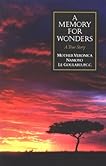
A Memory for Wonders: A True Story A Memory for Wonders: A True Story by Veronica Namoyo Le Goulard

My rating: 4 of 5 stars
I read this book from Ignatius Press many years ago. Mother Namoyo wrote her autobiography out of obedience to her religious superior, who directed her to write her story, much like St. Thérèse of Lisieux, in Story of a Soul. The forward is written by Mother Mary Francis, who wrote A Right to be Merry, another excellent book about the religious life.

Mother Namoyo grew up the only child of socialist atheist parents who kept their daughter from ever hearing any stories about God. Although she was born in France, her parents moved to North Africa, in part to keep her from any religious influence. Little did they know, her grandmother secretly baptized her before they left and planted a seed which would grow. Despite growing up without any religious instruction whatsoever, Mother Namoyo tells of the tremendous graces that were showered upon her and the how interior knowledge of Christ and his passion were made known to her.

This is a remarkable story with an equally remarkable ending. An inspiring read that I need to re-read soon.

View all my reviews >>

Thursday, July 02, 2009

Finding God in War and Peace

A Table in the Presence: The Dramatic Account of How a U.S. Marine Battalion Experienced God's Presence Amidst the Chaos of the War in Iraq A Table in the Presence: The Dramatic Account of How a U.S. Marine Battalion Experienced God's Presence Amidst the Chaos of the War in Iraq by LT. Carey H. Cash

My review

rating: 5 of 5 stars
I read this book because it was recommended to me by a dear friend and the person who baptized me, the author's father-in-law. I saw a great deal of influence of his saintly father-in-law in these pages.

This book tells the true story of the first Marine Battalion in Iraq, and their spiritual as well as military struggle there. LT. Cash, who is currently the President's chaplain at Camp David, is a man of true Christian faith, expressed as a Baptist Navy chaplain, but open to the ideas of a liturgical and sacramental faith such as is found in the Catholic form of worship.

As a Catholic, I found it reinforced my beliefs on the true presence of Christ in the Eucharist, the benefits of confession to a priest, the healing power of sacramentals, and the intercessory power of prayer. In fact, I was astounded as I read time after time of Chaplain Cash's account of God's providence in Iraq, how closely it aligned with my Catholic faith.

For example, Chaplain Cash explained how, as a Baptist minister, he was trained to explain the scriptures in order that worshippers could apply it to their daily lives. But he found the men going into battle didn't have the time or the inclination to listen to fine sermons. They primarily desired two things: confession (with absolution) and holy communion. As a Protestant, Cash could hear confessions and advise the penitent of their saviour's forgiveness, but he couldn't offer sacramental absolution. Also, I believe Chaplain Cash understood the men's need for holy communion as something greater than words. Despite the fact that the communion wafer was merely a symbol of Christ's body, the men desired mystical union with Christ before they went off into battle.

Chaplain Cash also spoke about seeing angels protecting them and the power of intercessory prayer and how much it meant to the men to know that people back home were praying for them.

Just as his father-in-law, Chaplain Larry Ellis, told me I would, I loved it.

If President Obama and his family spend more time at Evergreen chapel at Camp David, as Time magazine suggests, Chaplain Cash may have the opportunity to share his tremendous faith with our chief executive. I know, the White House "denies" these rumors. But perhaps the Obamas will find the spiritual solace they need at Camp David.

I can't help but think that is a good thing.

View all my reviews.

The reasonableness of Christianity

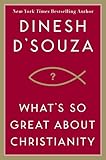
What's So Great About Christianity What's So Great About Christianity by Dinesh D'Souza

My review

rating: 5 of 5 stars
I had the opportunity to hear Dinesh D'Souza debate atheist Christopher Hitchens at CU Boulder this past winter (see my blog) and I heard this book mentioned.

D'Souza takes the opportunity to go into great depth into the topics that were touched upon at the debate. When I first began reading this book, I though it was just going to be a retelling of the debate I heard, but D'Souza goes into much greater detail here and without interruption and snide remarks from Hitchens.

This book should be on the required reading list of all Christians. D'Souza uses science, philosophy and atheism's own words to show the utter truth, beauty and logic of Christianity.

D'Souza denounces the atheism of Darwinism, while at the same time praising evolutionary theory as our "best guess" for the current type of life we have on earth. But don't sit back and think the argument is over. D'Souza goes on to point out all the questions that evolutionary theory can't answer, such as the complexity of the cell, or DNA strands or even the origin of life itself. Darwin's theory assumed life already existed, so current Darwinists' (such as Richard Dawkins) attempts to explain away evolution as a great way to avoid needing an Intelligent Designer, have basically shot themselves in the foot. They look very foolish trying to come up with increasingly complex ways of describing the origins of life, the origins of the universe and how it all began. D'Souza reveals Dawkins' bias against God and for atheistic evolution using Dawkins' own words: "The theory of evolution by cumulative natural selection is the only theory we know of that is in principle capable of explaining the existence of organized complexity. Even if the evidence did not favor it, it would still be the best theory available."[emphasis mine:].

One of my favorite chapters in the book is "The World Beyond our Senses: Kant and the Limits of Reason." I have never taken a class in philosophy and I know very little about the topic. But D'Souza does an excellent job at explaining the thinking behind the philosophical underpinnings of Kant and the limits of our senses. In brief, we can't use our senses to know God, "so", the atheists tell us, "He must not exist." Kant's reasoning was that reality is not what our senses tell us. In fact, there is much about reality and knowing and being that our senses can not inform us. For example, I can know what a dog is: what one looks like, smells like, feels like, sounds like. I can even cut him open and examine his insides and tell much about the biology of the dog. One thing I can not do, however, is know what it is like to actually "be" a dog. The reality of being a dog is something we, as humans can never know. It is beyond our reach. If we could put a camera inside a dogs head and follow it around and monitor brain waves and measure internal temperatures we still would only know what it is like to be a human observing a dog. We can never "be" a dog.

As D'Souza so aptly puts it, "Kant's accomplishment was to unmask the intellectual pretension of the Enlightenment: that reason and science are the only routes to reality and truth." Certainly modern education today, particularly at the university level, tells us that all we need to know we can know through reason and science. Religion is the crutch for the weak. The fairy tales for the unenlightened and uneducated.

But D'Souza continues steering us on the path he has laid. After our introduction to Kant, he takes us into the realm of miracles. Did you know that Christianity is the only major religion in the world today that depends upon miracles? Other religions may support or allow them, but only Christianity depends upon the miraculous. That would be the central tenet of Christianity--Christ's resurrection. At this the atheist scoffs. Virgin births and dead men come to life! How utterly absurd. Yet we have already read that Kant's secular reasoning has led us to the conclusion that we can't know everything through our senses alone. And the physicists have told us our physical laws are such that if altered even one iota (such as the gravitational force), we would not exist. Therefore, we have some indication that there is a great force beyond ourselves that we can't quite perceive. If that force is God, and God has created nature and the physical laws, then what sane person could deny He can alter them according to His plans? Thus we see the reasonableness of believing in miracles.

I can't recommend this book more strongly. I believe D'Souza's book ranks up there with Mere Christianity as being one of the foundational books every Christian should read.

View all my reviews.

An Evangelical returns to Rome

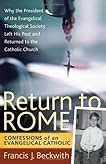
Return To Rome: Confessions of an Evangelical Catholic Return To Rome: Confessions of an Evangelical Catholic by Francis J. Beckwith

My review

rating: 4 of 5 stars
Francis J. Beckwith stunned the Protestant Evangelical world when he returned to the Catholic Church of his youth on April 29, 2007. This brief account from the former president of the Evangelical Theological Society (ETS) of why he left his prestigious post to return to the Catholic Church is a quick read, but at times extremely deep.

Francis Beckwith has a PhD from Fordham University and currently is a professor of philosophy and church-state studies at Balylor University (a Baptist school). Prior to his return to the Catholic Church he had written and co-authored many treatises on Protestant Reform theology, which he knows inside-out. He discusses the theological implications of Reform thinking with traditional Catholic understanding of issues from salvation and good works to the efficacy of the sacraments and Biblical inerrancy.

At times he seems almost too reserved in his attempt to avoid alienating any of his Protestant colleagues, but his charity and good will makes him all the more accessible to non-Catholics. He even has a blurb on the back cover of his book from the 2006 ETS president.

But I do like a good argument, so my favorite part of the book has to be the final chapter, where he explains the differences (as he sees it) between faithful Catholics and faithful Evangelicals. He even re-prints the ETS press release which they issued immediately after his resignation and his counter response to them.

Overall this is a very charitable and at the same time thoroughly engaging and readable book.

View all my reviews.

Wednesday, June 10, 2009

How Christianity Answers Everything

What's So Great About Christianity What's So Great About Christianity by Dinesh D'Souza

rating: 5 of 5 stars

My review


I had the opportunity to hear Dinesh D'Souza debate atheist Christopher Hitchens at CU Boulder this past winter (see my blog) and I heard this book mentioned.

D'Souza takes the opportunity to go into great depth into the topics that were touched upon at the debate. When I first began reading this book, I though it was just going to be a retelling of the debate I heard, but D'Souza goes into much greater detail here and without interruption and snide remarks from Hitchens.

I am about half-way through the book now and thoroughly enjoying it! I put the book on my "religion" shelf, but it could easily go under something like "philosopy of science" or "metaphysics" due to the fact that D'Souza discusses the "Big Bang" theory, Einstein's theory of relativity and Stephen Hawking's A Brief History of Time, among other things. He also doesn't shy away from the question of Biblical creation story vs. scientific theories of evolution, the so-called war between science and religion and other topics that have plagued Christianity in the modern age, such as Galileo and Copernicus and whether or not the Church stifled scientific progress (answer: on the contrary, the Church is the reason man made scientific advancements).

I will write a more thorough review when I'm finished.

View all my reviews.

Poetic Knowledge: The Art of Knowing

Poetic Knowledge: The Recovery of Education Poetic Knowledge: The Recovery of Education by James S. Taylor

My review

rating: 4 of 5 stars
My husband and I had the opportunity to meet Dr. Taylor and take him to dinner several years ago (1998 or 1999) when he was in Denver for a Catholic homeschooling conference.

We had a marvelous evening and learned so much from this man, who attended the Integrated Humanities Program at the University of Kansas which was a hotbed for Catholic conversions and making monks (dozens at Clear Creek Monastery in Oklahoma and the Abbey of Fontgombault in France), priests (Fr. James Jackson, FSSP) and bishops (e.g. Bishops Conley of Denver and Coakley of Salina, KS).

Dr. Taylor discusses the ideas of "poetic knowledge" as things we know with the core of our being, as opposed to things we learn by rote. For example, we know the smell in the air after a rain, or after the lawn has been cut. (Okay, so that's MY analogy, which is pretty poor...I read this book many years ago!) We are physical as well as spiritual beings and we need to learn with our whole beings, not just with our brains. Dr. Taylor's book is a wonderful complement to the Charlotte Mason approach to education as well as the Montessori approach (as taught by Maria Montessori and not by the dozens of New Agey schools that have sprouted up everywhere using her surname).

Not as delightful as sharing a bottle of wine with Dr. Taylor, this book may be the next best thing.

View all my reviews.

Friday, May 08, 2009

Brom Bones and Ichabod Crane, Hero or Victim?


I'm currently reading another book by Dr. Leonard Sax, author of Boys Adrift. This book is called, Why Gender Matters: What parents and teachers need to know about the emerging science of sex differences.

As I'm reading and going through my day, I keep noting little things that people do (myself included) and how it relates to the gender differences elaborated in the book.

Today, for example, I took my three little boys to see a student musical version of The Legend Sleepy Hollow. It was exceedingly well done, not surprisingly, because I know several of the performers and they have always put on a great show.

The thing that struck me about this particular show was the way in which Brom Bones and Ichabod Crane display the archetypal boy and the anomalous boy.

Brom Bones is tough, rather lunk-headed, strong, and self-centered. He's quite knowledgeable about farming and horses, but is not an intellectual, nor is he very good at telling Katrina his true feelings (if he even has feelings). He is a trouble-maker, and is known around town for playing pranks, including one which caused the last schoolmaster to leave town.

Ichabod Crane, is lanky, intellectual, superstitious and self-centered. He's quite knowledgeable about history, (particularly the history of New England witchcraft) and other standard school subjects. He's good at wooing the ladies with his amiable manner and quick wit. In fact, the ladies of the town seem quite taken with his culture and refinement.

Katrina, the love interest of both men, is taken in by Ichabod's culture and charm and Brom Bones is jealous and angry. He tells Ichabod to lay off his girl and to leave town, but Ichabod is committed to stay in Sleepy Hollow.

Just how and why Ichabod finally leaves Sleepy Hollow is the main tale being told, but Brom Bones is no wimp when it comes to the manly arts (courage, strength, risk-taking). While Ichabod, it struck me, is quite good at practicing some of the feminine arts (charm, culture, refinement).

I never really understood who the hero of this story was supposed to be. It always struck me as rather tragic. Until I watched it in the light of the science of gender study. Now it all makes sense!

To confirm my suspicions, I asked a group of boys, ages 7-13, who had just seen the show, who was their favorite character?

"The strong guy," was their nearly-unanimous answer.

After all, who wants to be the victim?

Thursday, April 30, 2009

How to keep your son from being a mama's boy

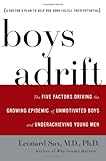
Boys Adrift: Five Factors Driving the Growing Epidemic of Unmotivated Boys and Underachieving Young Men Boys Adrift: Five Factors Driving the Growing Epidemic of Unmotivated Boys and Underachieving Young Men by Leonard Sax


My review

rating: 5 of 5 stars
I started reading this book after hearing about it from a mom of a teenage boy. Her son is a good kid: good student, practices his faith, athletic, mannerly, but she saw warning signs of how easily good kids can go astray when they don’t have someone to help guide them. If she was concerned about her son, I figured I ought to be concerned about mine, since I have five, and three of them still have many years before they enter the turbulent teens. Best to be prepared.

It didn’t take long before I couldn’t put the book down. Dr. Sax relates stories of real boys, told by real parents, and how they were often intelligent kids, who lacked motivation for school or life outside of video games. I could easily imagine any of my boys, given free reign, could easily turn into video zombies. Girls might spend too much time chatting with their friends on Facebook, but boys like to play action-packed video games until their eyes glaze over and their heads drop to the keyboard from lack of sleep. Neither food, nor school, nor senior prom can propel them from the game machine unless a parental foot on the backside gives them an extra boost.

So it was with a great deal of expectation that I read Dr. Sax’s book on the “growing epidemic of unmotivated boys and underachieving young men.”

I suspect everyone knows at least one (or dozens) of 18 to 30 year-old males who seem to have no motivation for doing much of anything with their lives, but are often content with their low-paying jobs and single status, quite frequently still living at home with Mom and Dad. Before you call me judgmental, look at the statistics: Women now outnumber men on college campuses and in medical and veterinary schools. The number of women entering traditionally male fields, such as engineering and technology, is increasing, while the number of men entering those fields is decreasing. Where are the men going? They’re dropping out of college, or not even entering in the first place.

Dr. Sax lists five reasons for the alarming trend of unmotivated males. No, it’s not all the fault video games, although that is the first reason he lists. The others are: the feminization of education, overuse of prescription medication (for ADHD), endocrine disruptors in the environment, and the devaluation of masculinity.

He makes compelling arguments for each of the five reasons and all parents of boys should educate themselves on these topics. The one I found most interesting, and the one I’d heard nothing about was endocrine disruptors in the environment. These are environmental pollutants caused from a variety of sources, including phthalates found in plastics such as plastic water and soda bottles, pacifiers and baby bottles. These endocrine disruptors have been shown to cause early onset of puberty in girls, while having the opposite effect on boys. According to Dr. Sax, “The overwhelming majority of modern chemicals that mimic the action of human sex hormones, curiously, mimic the action only of female hormones.” They have also been linked with the disruption of brain function in the area of memory and motivation, as well as ADHD, again, affecting girls differently than boys. He also refers to these chemicals as “environmental estrogen,” as they mimic those female hormones. Dr. Sax further gives evidence that the increase in childhood obesity can be directly linked to these environmental estrogens. There are other alarming symptoms as well: male genital abnormalities, lower testosterone levels and male infertility.

Another pollutant in our environment that affects males far more than females is pornography. (See my book review on The ABCs of Choosing a Good Husband). Men no longer need women for sex, just as women no longer need men for babies. As a result, men and women are putting off marriage until much later, or in many cases, forsaking it altogether. Dr. Sax cites the number of men ages thirty-five to forty who have never been married has tripled in the last thirty years. Just twenty-five years ago it was 8%. It currently stands at 22% and is rising rapidly.

Dr. Sax also mentions the rise of contraception as a cause of the divorce of marriage from sex. (Once again, Pope Paul VI was right). Dr. Sax says, “More and more boys are discovering that they prefer a sexy image on a computer screen to a real live woman with expectations…” Some of the physical results of this dependency on pornography are the increasing number of men who need Viagra or Cialis.

And now the good news:

Dr. Sax gives hope to concerned parents (and disaffected young males) by giving concrete examples of young men whose lives were turned around by some simple changes. Enroll in an all-boy school. Get off unnecessary medications. Get unhooked from the video games and get involved in athletic competitions. Have examples of manly behavior from men. Experience the real world by getting outdoors. Do something physically demanding. Sweat.

For more information read the book and go to the website: www.boysadrift.com and www.singlesexschools.org.

View all my reviews.

Tuesday, April 28, 2009

What Doctors Don't Know About Menopause

What Your Doctor May Not Tell You About Menopause: The Breakthrough Book on Natural Hormone Balance What Your Doctor May Not Tell You About Menopause: The Breakthrough Book on Natural Hormone Balance by John R. Lee


My review


rating: 5 of 5 stars
I'm still reading this book, but so far I'm impressed by the common-sense holistic approach Dr. Lee takes when it comes to treating women who are experiencing change of life and hormonal issues associated with menopause.

I've been having some dermatological problems for about 1 1/2 years, during which time I've been to a nurse practitioner, family practice primary care physician and numerous visits to a dermatologist. I began to suspect my problems were hormonal when the powerful medications, ointments and creams prescribed by the above medical professionals failed to give me much relief and the skin problems appeared about the same time I experience an increase in my middle...even though I was exercising frequently and I had just completed a swim marathon (26 miles in 4 weeks), I seemed to have developed a "life-saver" of padding around my waistline. I figured it was due to swimming, so I laid off swimming and went back to aerobic exercise and weight-training. Some of the padding came off, but I still seem to have more of "me" than I would like.

I had a few other minor symptoms of pre-menopause, so I started thinking maybe my skin issues were hormonally caused.

Dr. Lee's book makes mention of these and other symptoms being helped by natural progesterone cream. (Note: not all creams are created equal, so he gives a list of some of the "good" ones in the back of his book).

After only one day of using the cream, I feel incredibly better. I think my skin looks better too. Even my husband said to me this morning, "You look more hopeful than you have in a long time!"

I realize this could be the placebo effect, so I'm taking my time and keeping notes before I announce a "miracle cure," but if this can help another woman experiencing hormonal issues, I wanted to get the word out.

By the way, I have used this natural progesterone cream made from wild yams once before in my life. It was after a particularly debilitating miscarriage after 14 weeks of pregnancy. My midwife recommended it to help prevent another miscarriage, as I wanted to get pregnant again soon. I used it and was pregnant very soon after the miscarriage. That little boy is 9 years old now.

View all my reviews.

Monday, April 06, 2009

Mea Culpa: my revised book review on the Duggars

The Duggars: 20 and Counting!: Raising One of America's Largest Families—How They Do It The Duggars: 20 and Counting!: Raising One of America's Largest Families—How They Do It by Michelle Duggar

My review

rating: 2 of 5 stars
Here's my revised review:


I have to correct some of the things I wrote after my initial read of this book. I confess I found myself falling far short of the cheerful and organized family I was reading about in the book and I was a tinge jealous of their huge house and amazing children. I wrote: "Tiresome! I like to read books by and about large families...trying to get some ideas for a book I'd like to write someday. What I definitely want to avoid is the 'holier than thou' preaching I found throughout this book. I also want to try to avoid the 'I know everything because I'm a mom of (fill in the blank with however many kids Michelle Duggar has at the moment).'"

Okay, so maybe that was a bit harsh and judgmental...

After some examination of conscience, I felt I needed to apologize for that untrue remark. Michelle Duggar is not "holier than thou." Her only fault might be in her unadulterated cheerfulness at being one of the most unabashedly fecund mothers currently living on the planet.
I did take exception to a few of her comments, specifically the sidebar that quotes her saying that breastfeeding doesn't prevent you from getting pregnant. I believe she misunderstands the concept of breastfeeding on demand and breastfeeding for comfort as well as for food. This was the only way I found breastfeeding to accompany infertility. Since there are photos of her newborn with a pacifier in her mouth, Michelle Duggar obviously isn't breastfeeding her newborns for comfort, thus she isn't using breastfeeding to space her babies.

Michelle has certainly taken her share of criticism for her large brood and I don't want to add to that. She also has some good ideas for feeding many mouths. But I don't see the need for "industrial" sized everything. Most of us "normal" families with more than 2.1 kids don't have the money or the space for an industrial sized kitchen or laundry room and we have to make do with the normal sized kitchens and laundry rooms we have. Most of us don't have the 10,000 square foot home the Duggars have either. And most of us don't live in rural Arkansas, where we could afford to buy the land to build our 10,000 sq. ft dream home either! I love the Duggars, but I just wish they were a bit more like my family so I could relate to them better.

Still, I think I can learn a thing or two from Michelle Duggar, that is once I get over the fact that her husband is named "Jim Bob" and each of their 18 children has a name that also begins with "J"!

View all my reviews.