Showing posts with label gardening. Show all posts

Wednesday, March 24, 2010

Tasha Tudor's Garden and the Joy of Beauty

Tasha Tudor's Garden Tasha Tudor's Garden by Tovah Martin


My rating: 4 of 5 stars

Sometimes I think I was born in the wrong century. I sometimes fantasize about living in a hand-hewn cozy cottage with a wood-fired cooking stove apart from the noise and congestion of city life. I would love to bake my own bread, raise my own laying hens, milk my own nanny goats and make yogurt and cheese. I would love to rely solely on my hardy pioneer stock and bypass technology (save for the ease with which I could obtain the basic necessities of life…and probably indoor plumbing…and central heating). Hey, it’s my fantasy world.

Yet, here I am, blogging mommy; a Twittering, Facebooking, Linkedin technology embracing 21st century inhabitant.

There are some modern pleasures to which I haven’t succumbed. We don’t have cable or satellite television or a flat-screened TV. I don’t have an iPhone, iPod, Blackberry or a space-aged looking device permanently stuck to my ear.

I do bake my own bread from time to time with grain that I grind myself (in a modern, convenient and easy-to-use electric grinder). I make my own yogurt occasionally and I have sour dough starter on my kitchen counter. I grow an excessively huge vegetable garden each summer, with varying degrees of success and I like to make jams, jellies, pickles and preserves with the abundance. I sew, knit, quilt, cut my kids' hair and in general try to make the world a more beautiful place. (I said try.)

I sometimes feel torn between the two worlds—my fantasy world, which I would love to inhabit, and the real world that I actually do inhabit.

My recent musings were brought on because I just finished reading
Tasha Tudor's Garden, by Tovah Martin, which is profusely illustrated with stunning photographs of Tudor’s Vermont hilltop home and her 250-acre botanical heaven-on-earth. (An aside for those of you who are ignorant of Tasha Tudor, as was my husband. His response when I told him I was reading a book about Tasha Tudor was, “Who’s Tasha Tudor?” This from the man with whom you never, ever want to play Trivial Pursuit. He’s got places, dates and geographic locations permanently etched in his brain. Need to know the capital of Burkina Faso? The capital is Ouagadougou. It used to be called Upper Volta, he tells me. Anyway, Tasha Tudor was a prolific illustrator whose illustrations transport you to another time and place. She was born in 1915 and died just recently, in June 2008. Although she lived in the 20th century, her lifestyle, dress, home and garden were deeply rooted in the 19th century, if not earlier).

This is a visually stunning book that transports the reader to another time and place. I would liked to have read more about Tasha Tudor, but this book really isn’t about her, it’s about her garden, and ultimately about beauty. The pictures transported me to a time and place that is so different from my own, which perhaps is why I find it so appealing. My Colorado garden could never compare to her Vermont hilltop garden. She has moisture and rich soil whereas I have dry clay and rock. She evidently relies on nature to water her garden most of the time, whereas I pay double for Arvada water since I live outside city limits. Because of this, if you come see my garden in late July or August, you’ll usually find my grass a dull green, if not brown-tinged because I’ve diverted all the precious water to the vegetables.

I was disappointed the book didn’t have pictures of her heated greenhouse. It made mention of its lovely camellias which brighten her home in the winter, but no pictures. I can only suspect the greenhouse doesn’t follow the proscriptions of imitating 19th century. It’s probably the technological reason for the stunning beauty of her flowers.

Really, the book is about beauty and not about living a certain lifestyle. Her eccentric dress and lack of 21st century technology may be about her own quirkiness, but they are also beautiful in themselves. Because she spent so much time nurturing her garden by hand, collecting and arranging lovely vases of flowers and painting the exquisite scenes before her, we, the readers, get to enjoy the many images of beauty.

Technology (like this blog I’m writing right now) has done much to spread ideas and information. But we can’t live authentic lives if we don’t allow ourselves to be nurtured by beauty. It easy to be distracted by the technology itself: flashy images, surround sound, instant access. But without beauty in our lives, we are only half-human. If I learned one thing from this charming book, it is that I need to be more mindful of the beauty around me; to nurture and protect it like Tasha nurtured and protected her lilies, roses, peonies, poppies and even the lowly pansies. She cared deeply about each of her botanicals, often calling them by name and always ready to give a history of their planting and heritage. When a frost was predicted, she’d hasten outside to cover the vines of her Concord grapes with laundry, or she’d lay a deep layer of mulch around a tender plant like a mother covers her sleeping child with a blanket at night. Tasha Tudor understood beauty and our human need for it.

View all my reviews >>

Friday, January 22, 2010

Via Media

Via Media, or "the middle way," refers to the idea of avoiding the extreme; it is also defined as "a mean between two extremes."

Do most Americans have moderate views? Are most Americans content to be left alone to live their lives without too much government interference? I think so.

I suspect most of us would define ourselves as "moderate." I consider myself an extremely moderate person, yet I know many folks would disagree and call me a "pro-life, pro-chastity, home-birthing, breastfeeding, organic gardening Catholic homeschooling mother of ten." But I don't see these things as extreme. In fact, I see them as an extremely moderate way of living.

Here's why:

Pro-life: Justice Blackmun, writing for the majority in the 1973 Supreme Court decision, Roe vs. Wade, said: "We need not resolve the difficult question of when life begins. When those trained in the respective disciplines of medicine, philosophy, and theology are unable to arrive at any consensus, the judiciary, at this point in the development of man's knowledge, is not in a position to speculate as to the answer."

If it is true (which I don't believe it is), that science can not determine when life begins (or agree with philosophy and theology...not that the Supreme Court really cares what philosophers and theologians have to say), then preference should be given to the possibility of life being present. For if we are truly moderate, we would say, "preserve life if it is present, and do not destroy it if there is any doubt."

Pro-chastity: Premarital and extra-marital sex have spawned a catastrophic increase in STDs (sexually transmitted diseases), a surge in unwed motherhood and increasing divorce rates. The chief criticism of chastity education is, "It doesn't work." Perhaps it is not that chastity itself "doesn't work," but that it is difficult. It is also difficult to run a marathon, yet look at the number of people who do that every year; or to lose one hundred pounds, but look at the hit show The Biggest Loser and see how we applaud folks who do that. To rephrase a G.K. Chesterton quote: "Chastity has not been tried and found wanting; it has been found difficult and not tried."

Homebirth: Less invasive, more natural, fewer post-natal problems. Obviously it's not for high-risk pregnancies, but for most low-risk births, it is a cost-saving and very pleasant alternative to hospital births.

Breastfeeding: Natural, good for baby, good for mom, what's not to like? Okay, stupid comments from uninformed people; otherwise, a very "moderate" way to feed the baby.

Organic gardening: We compost most of our kitchen waste, which makes a great additive to our clay soil. For the past few years I've been trying to get away from hybrid species and plant solely heirloom varieties. It's not only fun and educational, but it helps preserve rare species which are disappearing at an alarming rate due to large-scale production farming.

Catholic: The word "catholic" means "universal" and the early Christian Church adopted this term to show the universality of the Church that was planting seeds throughout the world. We don't have suicide bombers and we try to practice the teachings of our founder, who said some pretty extreme things like "Love your neighbor as yourself." He also died for the sins of others. Okay, maybe that does make me a little on the extreme side, but I haven't perfected any of those things yet, so I can still be called "moderate."

Homeschooling: The passing down of information from one generation to the next has been the way of education since the dawn of time. We're just a little more organized these days.

Mom of ten: Maybe by today's standards that's extreme, but the real reason I have so many kids is because I need them to keep me on the straight and narrow. There's no telling what trouble I might be getting myself into if I wasn't running after them. One thing I have noticed with having ten kids is that love doesn't diminish when your family grows. Love only grows. The thing we notice when someone is gone is how quiet and empty the house feels.

Let's hear it for radical moderation! Believe to the extreme. Hope to the extreme. Love to the extreme.

Love is the ultimate via media.

But now faith, hope, love, abide these three; but the greatest of these is love. 1 Cor 13:13

Tuesday, July 21, 2009

Acts of God (not the good kind)


Last night around 10:30 p.m. we had a whopper of a hail storm. This spring had been pretty quiet for us weather-wise. We'd had more rain than normal (waaayyy more rain than normal), but had escaped all the hail and tornadoes that had done damage to other parts of the Denver metro area earlier in the summer.


There were still piles of hail, several inches deep the next morning.
This used to be lettuce.

This used to be pumpkins and winter squash.

This used to be cucumbers and beans.

There used to be lettuce, kale, cabbages, broccoli and peppers here.

Only a few grapes remain on the vine.

The remnants of the sunflower house and bean teepee...

Whats left of the tomato plants in the cages (a dozen different heirloom varieties!) and some shredded beans by the poles...

At least we just had minor damage. My garden was pretty much wiped out, our siding has some holes in it, some of our window screens are ripped and we had some water seep into the patio room...

The front of the house covered in leaves (and some hail still on the roof from the night before).


...and our lovely dining canopy was shredded.

But, by the grace of God, we didn't have anything terribly serious. No major structural damage, no big tree limbs down, no loss of power, nobody hurt. Now we'll see if any of the garden recovers. Maybe the tomatoes can bounce back. I'm pretty sure the pumpkins, grapes and basil won't. I can re-plant the lettuce and some cabbages for the fall. The beans and sunflowers will probably recover. I'll take more pictures as soon as something new and green begins to grow!

Thursday, March 05, 2009

Gardening for Fun and Profit

Time to think about putting in a garden!

If you've never had a vegetable garden, here are some ideas to get you started.

Find a sunny windowsill where seedlings won't be disturbed and you can check on them daily. Or, you can set up some grow lights (pictured here using shop lights with full-spectrum fluorescent lights installed).

Before you go out and buy seeds, plan where your garden will be and how big it will be. Keep in mind, once summertime heat kicks in, you'll be out there tending to the weeds that inevitably grow several inches overnight! Carefully read the planting instructions for the vegetables that you decide to grow. Some do well in short, hot summers (like we have here in Denver). Others do well in cooler, more temperate weather. Some vegies really need to be started indoors due to their longer maturity time (like tomatoes, peppers and some herbs). Other vegies like to be planted directly into warm soil outdoors (like squash, pumpkins, cucumbers, carrots, radishes), while others need to be planted before the temp gets too warm (like peas and lettuce).

Last year I tried to plant my sweet peas around St. Patrick's Day, even though, here in the 'burbs of Denver, we are hardly out of the winter season by that time. It was the first time I tried something so daring. I even threw out a few lettuce seeds, just to see what would happen. Lo and behold! They sprouted and I actually my first decent crop of sweet peas since I began gardening in the harsh climate of Denver.

Soon I'll be getting out my shop lights and setting up the grow area in the patio room. Last year was the first year I tried this set-up. Our patio room isn't insulated and the temps can drop to freezing or below until around Mother's Day. Nevertheless, the patio room was temperate enough to keep my young seedlings from freezing. It probably helped that I had a warming mat, designed especially for starting seedlings, under one of the trays with tomato seeds, and the grow lights provide some warmth. I had the lights on a timer, so they go off at night to give the seedlings some rest, but I kept the mat on 24/7. It was only under one of about twelve trays, so it was only a slight help.

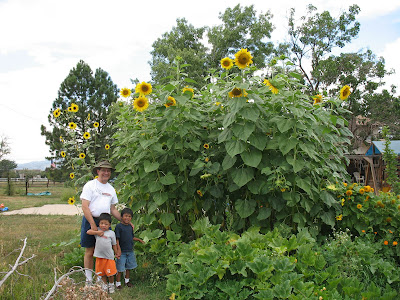
Once the soil warms and the danger of frost is past, the kids help me plant a sunflower house. Here are some pictures chronicling the growth of our house a couple years ago. I was afraid we'd started the house too late, since we started in on Memorial Day weekend, and it seemed to grow very slowly in the beginning. After about 6 weeks it looked like this:
About two weeks later it looked like this:

And by late summer, we could go inside our sunflower house and find a cool retreat from the day, like this:


Happy gardening!